Showing posts with label Clarence Thomas. Show all posts

100 lawprofs ask Congress to impose an ethics code on the Supreme Court.

Oddly, the name Koch appears 10 times in this Washington Post article. It appears that some lawprof brains are aboil with worries about the nefarious Koch brothers. Kochophobia rages on, and these furious minds seem to imagine themselves overcoming the evil that is Antonin Scalia and Clarence Thomas — as if their "ethics" plan — assuming it could be put in place — couldn't possibly backfire and oust their favorite liberal/swing justice.
The professors said in their letter to the committees that their goal is not to second-guess the activities of any individual judge but to create "mandatory and enforceable rules to protect the integrity of the Supreme Court." An influential British judge declared in the 17th century that "no man may be a judge in his own case," the letter said, but "inexplicably we still allow Supreme Court justices to be the sole judge of themselves on recusal issues."
And what man will be the judge of whether these law professors are truthfully reporting their motives?
Under the ethics code that the lawyers consider their model, approved and regularly updated by the nation's chief appellate judges under the chairmanship of the chief justice, lesser judges are prohibited from accepting travel reimbursements from outside groups if they "give the appearance of influencing the judge" or "otherwise give the appearance of impropriety."

Nan Aron, director of the liberal group Alliance for Justice, said that if these rules were extended to the Supreme Court, none of the justices could attend "overtly political meetings or events" like those sponsored by the Kochs.
And who will be the judge of which meetings and events are overtly political? If they're sponsored by the Kochs, they're political. So far, we know that. Thanks a lot. I love the irony. It's obvious that this proposal is overtly political!
At present, said Ellen Yaroshefsky, director of the Jacob Burns Ethics Center at the Benjamin Cardozo School of Law, "we have standard-less standards" at the court that she struggles to explain to students.

She said it would be straightforward for the court to appoint an independent body of retired justices or other experts to adjudicate recusal and ethics controversies.
Oh, wonderful! An independent body of retired justices or other experts. Yes, wouldn't it be great to have an independent body of retired justices or other experts decide which Supreme Court Justices got to participate in particular cases?

So... retired Justices Souter, Stevens, and O'Connor might step up to decide who to disqualify in — let's say — the case about the constitutionality of the individual mandate. Maybe you think that skews a tad liberal, a tad too anti-Scalia-and-Thomas. Well, first, that's not a bug, it's a feature. And, second, whoever is setting up the "independent body" could always balance it with those  "other experts." You know where to get them, don't you? Elite law schools! Begin with the names of those 100 professors who signed that letter to Congress.

It's all so delightfully inbred — isn't it? — in the feverish fantasy life of the Scalia- and Thomas-haters of legal academia.

"Where are the liberal civil rights leaders in response to the openly racist comments and calls for violence against America's black Supreme Court Justice?"

"These same men -- all men, I believe, as per usual with the black civil rights groups -- got all in a multi-week, if not many month, tizzy with their allegation that what obviously was a 'say it don't spray it' situation at a Tea Party rally was a spit attack on a black Member of Congress, but they evidently do not care when persons at an event affiliated with one of the nation's most established liberal groups, Common Cause, publicly say they want Clarence Thomas physically attacked and put into slavery."

Says Amy Ridenour, via Instapundit, who uses the word "hypocrisy." It's something beyond hypocrisy, though, I think.

"Indeed, there is an internal logic to Santorum's remarks that represents the exact opposite of racism."

Concedes Joe Klein, who supports abortion rights.

ADDED: James Taranto:
Klein ... misses the point.... What makes it racially invidious is not the underlying argument or the rhetorical inelegance with which Santorum makes it. It is the implication that because Obama is "a black man," he is obliged to agree with Santorum.

The notion that the range of acceptable opinion is narrower for a black person than for a white person (or for a woman than a man, or a homosexual than a heterosexual) is a pernicious form of bigotry. It is usually heard from left-wing multiculturalists, as when they attack Clarence Thomas for being black and taking the position that racial preferences are unconstitutional....

"Lillian McEwen breaks her 19-year silence about Justice Clarence Thomas."

The Washington Post has the scoop, including what may be the key sentence: "She has written a memoir, which she is now shopping to publishers."

UPDATE: McEwan in a interview reveals that she had an intimate relationship with Thomas. She says he liked pornography, especially depictions of large breasts. What is the point of revealing something so incredibly banal? Does it corroborate Anita Hill's testimony in any significant way? The issue, in the confirmation hearing, was whether Thomas engaged in sexual harassment in the workplace. McEwan is talking about his private life. First, that's really creepy. Imagine if a man revealed private, sexual things about a woman. McEwan even admits that she's speaking now because she is politically opposed to Clarence Thomas. She doesn't like the way he's deciding the cases.

Since McEwan never says that Thomas talked about pornography in the office, the supposed corroboration is virtually nil. It's true that if we know a man is interested in pornography, it makes it more likely that he talked about that interest somewhere, more likely than if we didn't know whether the man liked pornography. But huge numbers of men are interested in pornography, and only  a small subset of them who pester women by talking about it graphically in the office environment. So it just doesn't matter enough to bring it up.

McEwan also talks about the way Thomas thought about women, but it comes across as sheer speculation. She somehow knows he thought about whether women he met in the office would make good sexual partners. Again, this is perfectly banal. It says little about how he might attempt to initiate a relationship with a coworker. Doesn't nearly every single adult look around at other people and think about whether they are attractive and might make a good sexual partner?

This is just sad and embarrassing.

Slate and Stupid: William Saletan's cocky ignorance of the First Amendment.

I'm turning William Saletan's headline back on him.
.... The key exchange begins just after the 17-minute mark. Here's my transcription:
Coons: The First Amendment establishes the separation, the fact that the federal government shall not establish any religion, and decisional law by the Supreme Court over many, many decades—

O'Donnell: The First Amendment does?
... In expressing her disbelief, she clearly emphasizes the word first.  She seems incredulous not just at Coons' position against government-established religion, but that he bases it on the First Amendment. It's the citation that surprises her.
Perhaps she emphasized "First" because the discussion had been about what local school boards could do, and restrictions on them would need to come out of the 14th Amendment.* Now, Coons does properly restrict his assertion to the federal government at that point, but:
A minute later, O'Donnell brings the discussion back to this question:
O'Donnell: Let me just clarify: You're telling me that the separation of church and state is found in the First Amendment?

Coons: Government shall make no establishment of religion.

O'Donnell: That's in the First Amendment.
Again, you need the audio, and in this case full-screen video, to get her meaning. As she says, "That's in the First Amendment," she stares at Coons with a look of contemptuous amusement. (You can see her expression more clearly in this video, about 7 minutes in.) Then she grins knowingly at somebody in the audience. She thinks Coons has just embarrassed himself.
"Government shall make no establishment of religion" is a blatant misstatement of the Establishment Clause of the First Amendment. ("Congress shall make no law respecting an establishment of religion...") Now, I'm not trying to skewer Coons for saying that. Coons is doing well enough for speaking purposes. This isn't scholarly writing. But he's open to questioning, and O'Donnell might have pursued the point. Maybe she grinned because she knew he'd said something wrong.

Saletan proceeds, on this scanty evidence, to insist that the real problem with O'Donnell is that she is too confident when she speaks. Supposedly, that makes her "impervious" to new information and arguments, and that would be bad. Yeah, it would be bad. But this is a political debate! It's not the time to make a show of uncertainty and doubt. It's a time to state clear positions so voters can make a choice. I'm sure if O'Donnell had seemed uncertain about what to think, Saletan would have attacked her for her weakness. Instead, he's left criticizing her for "imperviousness." That's really lame. It reminds me of the way people of the left were always calling George Bush "incurious." It might make some sense if an ever-searching, ever-questioning intelligence was demanded of every candidate, across the political spectrum, but it is not.

My working theory is that it's Saletan who is impervious — and incurious. But I will continue, as ever, to search and question (and be, as ever, completely ill-suited to run for political office).

________________________

* The 14th Amendment — the Supreme Court has held — incorporates the Establishment Clause and makes it applicable to state and local government. There is, by the way, an impressive argument that the incorporation of the Establishment Clause was a mistake. Justice Thomas makes that argument here. I would not be surprised if O'Donnell would, as Senator, enthusiastically vote to confirm more federal judges who think like Clarence Thomas. And that's certainly something Delaware voters should take into account.

"The true measure of affirmative action's staying power is that its absence now is virtually inconceivable."

Writes Harvard lawprof Randall Kennedy:
Liberalism has made racial homogeneity uncool and unacceptable. Even many conservatives are made uncomfortable by lily-white gatherings -- hence the enhanced value to the right of Clarence Thomas, Shelby Steele, Condoleezza Rice, Linda Chavez, and any well-spoken Negro or Latino who consorts with the Tea Party crowd. That conservatives practice affirmative action even as they condemn it is a tribute to liberalism's handiwork.

Clarence Thomas is not here to entertain you, and Elena Kagan isn't very popular.

"I am not there to entertain anybody," says Clarence Thomas, disparaging Supreme Court oral argument, in which he famously refrains from participating:
[At the Utah State Bar’s 2010 summer convention yesterday, Thomas said], oral argument was an opportunity for attorneys to tease out their case.

When he first arrived on the court, members “actually listened to lawyers,” Thomas said. “We have ceased doing that. Now it’s become a debate or seminar. I don’t find that particularly helpful. It may be entertaining, but I am not there to entertain anybody.”

“There can be some questions to clarify things, to challenge it, but you don’t need 50 questions per case,” Thomas said. “That becomes more like “Family Feud” than oral argument.”
Here's another analogy: "I would equate trying to get the members of the court to do what you want them to do with herding gnats in a hurricane." That's especially interesting in light of the way some people imagine that Elena Kagan will somehow coax or cajole the others — or Anthony Kennedy — to go her way. Here's what Dahlia Lithwick said about that, back in May:
Obama—who could announce his pick as soon as this week, and the heavy betting is on Solicitor General Elena Kagan—is looking for a diplomat who will forge consensus, build bridges, and bring together a polarized court....

[J]ust because Kagan hired several conservative scholars when she was dean at Harvard Law School doesn't mean she'll have some kind of stunning intellectual influence over the Roberts Court's conservatives....

[R]educing the search for a Stevens replacement to a quest for the most able logroller on the left does nothing to dispel the widespread public perception that conservative judges closely read the Constitution and apply the law, while liberals stick a finger in the wind and then work the room. The selection of a new Supreme Court candidate should be an opportunity for the president to answer that claim with a crystal-clear message about the nature of liberal jurisprudence. "We think she might be able to flip Kennedy," is neither a powerful nor inspiring judicial vision....

Perhaps President Obama shouldn't be so quick to denigrate a nominee whose greatest impact on the court will be writing passionate dissents. Once upon a time that passionate dissenter was Justice Antonin Scalia. And if the sometimes-prickly justice has proved anything in recent years, it's that decades of bitter and brilliant dissenting opinions can be more influential over the long haul than all the negotiation skills in the world.
So the liberal Lithwick wanted more of prickly hothead. Instead, she and we got the supposedly charming Kagan, who, for some reason, is the least popular Supreme Court nominee — successful nominee — since Gallup started polling people, at the time of the Bork nomination. (Bork and Harriet Miers, unsuccessful nominees,  were less popular than Kagan.) Why is that? Could it possibly be that Americans don't like the idea of a Supreme Court Justice who is best known for social skills?

Why isn't Kagan more popular?
She seems to be more about social than legal skill and people think that's wrong.
She didn't say or do anything in the confirmation hearings that made any kind of impression.
She's supported by Democrats, and people are afraid of Democrats now.
There's prejudice against her based on her sex and her religious background.
There's a lot of free-floating unhappiness these days making people give negative answers to polls.

  
pollcode.com free polls

"It is not just the Clinton-Lewinsky affair that has generated invocations of 'Rashomon' in recent years."

"'Rashomon' got a workout back when the Senate deliberated over the confirmation of Supreme Court Justice Clarence Thomas."

From an essay I published back in 2000 that raises some ideas I've been thinking about in connection with the accusations against Al Gore.

I was reading the transcript of the accuser's statement to the police and thinking about how you could film that story — exactly that — in 3 versions: 1. Gore as a violent, misogynistic monster, 2. Gore as an awkward man in search of love who has little sense of the furious thoughts in the massage therapist's mind, and 3. A complex story of 2 imperfect adults.

ADDED: In "Rashomon," the 4 versions of the story are built around a set of external facts: a dead Samurai whose sword and dagger are both missing. In my proposed 3-act play, what will remain the same is the set of outward facts in the accuser's transcript. Yes, in real life, the woman may be lying. I want to assume that every word she says was spoken was in fact spoken — release the second chakra, etc. — and every action she says took place — the hug, the chocolates, etc. — in fact took place. That is, I'll write a screenplay with all the internal dialogue and feelings stripped out. Then 2 highly skilled actors play the script 3 times, with the 3 directions stated above. I think it can be done, and I think it would be a fascinating study. What does that have to do with the real question of what Al Gore did? It would get us away from the woman's subjective experience and allow us to focus on Gore's culpability — his subjective experience. Of course, it's still possible that the woman is lying or has some of the facts wrong. I'm not trying to brush that aside. I only want to try to figure out whether, if what she said is true, Gore might not be as bad as he seems when you read the transcript that is, unedited, filled with internal dialogue and descriptions of her feelings.

The Supreme Court's new federalism decision.

United States v. Comstock, today's Supreme Court case upholding the federal civil-commitment statute, deals only with the question whether Congress has an enumerated power to make a law that authorizes the continued detention of sexual dangerous or mentally ill persons after they have completed serving their federal prison sentences. That is, the case is not about whether there is an individual right to be free of this deprivation of liberty — only whether the federal government can do it.

On this federalism question, the Court relies on the Necessary and Proper Clause of the Constitution. The persons who are detained have, in every case, been convicted of federal crimes. If there was federal power to create those crimes and to impose criminal punishment for them, then why wouldn't it follow that the federal government could do something more to those individuals? Justice Breyer writes for the majority: "the same enumerated power that justifies the creation of a federal criminal statute... justifies civil commitment...."
[T]he statute is a “necessary and proper” means of exercising the federal authority that permits Congress to create federal criminal laws, to punish their violation, to imprison violators, to provide appropriately for those imprisoned, and to maintain the security of those who are not imprisoned but who may be affected by the federal imprisonment of others. The Constitution consequently authorizes Congress to enact the statute.
Justice Kennedy writes separately to note that federalism concerns have been adequately tended to: "this is a discrete and narrow exercise of authority over a small class of persons already subject to the federal power." Ditto Alito: "This is not a case in which it is merely possible for a court to think of a rational basis on which Congress might have perceived an attenuated link between the powers underlying the federal criminal statutes and the challenged civil commitment provision. Here, there is a substantial link to Congress’ constitutional powers."

Justice Thomas dissents (joined by Justice Scalia):
Absent congressional action that is in accordance with, or necessary and proper to, an enumerated power, the duty to protect citizens from violent crime, including acts of sexual violence, belongs solely to the States....

Not long ago, this Court described the Necessary and Proper Clause as “the last, best hope of those who defend ultra vires congressional action.” ... Regrettably, today’s opinion breathes new life into that Clause, and... comes perilously close to transforming the Necessary and Proper Clause into a basis for the federal police power that “we always have rejected"... In so doing, the Court endorses the precise abuse of power Article I is designed to prevent—the use of a limited grant of authority as a “pretext . . . for the accomplishment of objects not intrusted to the government.”

Constitutionally, death is different... youth is different.

(Also posted at Instapundit.)

WITHOUT MURDER, it's cruel and unusual punishment to sentence a juvenile to life in prison without parole, writes Justice Kennedy for a 6-3 Court. Dissenting, Justice Thomas criticizes the majority for imposing "an exacting constraint on democratic sentencing choices based on ... such an untestable philosophical conclusion": "that a 17-year-old who pulls the trigger on a firearm can demonstrate sufficient depravity and irredeemability to be denied reentry into society, but... a 17-year-old who rapes an 8- year-old and leaves her for dead does not."

"Racist Harvard Law Email: The Cat Fight That Turned Into a National Scandal."

Oh, no!

We cannot absolutely rule out the the possibility that women are, on average, genetically predisposed to be....

Ha. How horribly, embarrassingly messy for everyone at Harvard who took the bait. They got sucked into the vortex. They got played.

AND:  David Lat has some details. And some opinion:
Heck, this episode probably won’t even stop Steph from landing a Supreme Court clerkship. If I were in her shoes, I’d focus my efforts on Justice Clarence Thomas. Of all the members of the Court, he’d probably be most open to hiring the victim of what some conservatives might call, to paraphrase CT himself, the “high-tech lynching [of conservative females] who in any way deign to think for themselves, to do for themselves, to have different ideas.”
He also has an update from the woman whom some accused of leaking the email. She writes:
There was no fight over a guy (this isn’t Mean Girls). I certainly didn’t yell that I would ruin Stephanie’s life.

Moreover, I didn’t forward the e-mail to BLSA, anyone in BLSA, or ATL....

I know that you would prefer anything related to two girls to be a catfight... but that just isn’t how it happened.

***

If you're trying to remember the "Seinfeld" reference for "cat fight," it's "The Summer of George":
Jerry: Did you tell Peterman about this?

Elaine: Well, I tried, but he thought it was some sort of cat fight.

Kramer: Cat fight?

Elaine: Ok, why? Why do guys do this? What is so appealing to men about a cat fight?

Kramer: Yeye cat fight!

"If my colleagues would let me talk..." — Justice Thomas jokes about why he doesn't speak at oral argument.

Scroll to 33:40 in this video of Thomas's Q&A with University of Florida Law School students.

Clarence Thomas loves to hang out with law students "at their joints, with dead animals on the wall, and old tags... and food I can't eat."

And for law clerks he chooses "the kids I like," with "a preference for non-Ivy League law clerks," because "I'm not part of this new or faux nobility."

ADDED: The discussion of law clerks begins about 39 minutes into this video of Thomas's remarks at the University of Florida Law School. He says he thinks it's important to have diversity, and his idea is to concentrate on his circuit, the 11th Circuit. So he'll look for law students who are near the top of the class in schools in that circuit (which includes Florida).

He's explicitly scornful of the bloggers who refer to the students at the less highly ranked law schools as "TTT" or "third tier trash." It's interesting to me that he's paying attention to the blogs (and, of course, I'm not one of the bloggers who would ever use that term). He also speaks of wanting to visit law schools in his circuit. He has a touching dedication to the southeastern United States.

By the way, this talk at UF consists entirely of responses to student questions, and the questions are excellent. If you go to that 39 minute mark and watch the part about law clerks, keep going. The next question — at about 42:30 — is about natural law.

AND: The material about hanging out with law students is at about 46:30 in the video. He goes on to say "I don't dislike the professors, but I come to law schools to see the students." He doesn't like big events, and he thinks it has something to do with his desire, long ago, to be a priest. He speaks with a real passion for spending time with students.

Justice Thomas presents the notion of First Amendment freedom for corporations in a sympathetic light.

"If 10 of you got together and decided to speak, just as a group, you’d say you have First Amendment rights to speak and the First Amendment right of association. If you all then formed a partnership to speak, you’d say we still have that First Amendment right to speak and of association. But what if you put yourself in a corporate form?"

Why wasn't here there at the State of the Union address, mouthing "not true" along with Justice Alito?
I don’t go because it has become so partisan and it’s very uncomfortable for a judge to sit there. There’s a lot that you don’t hear on TV — the catcalls, the whooping and hollering and under-the-breath comments.
One of the consequences [presumably of Alito's display] is now the court becomes part of the conversation, if you want to call it that, in the speeches. It’s just an example of why I don’t go.

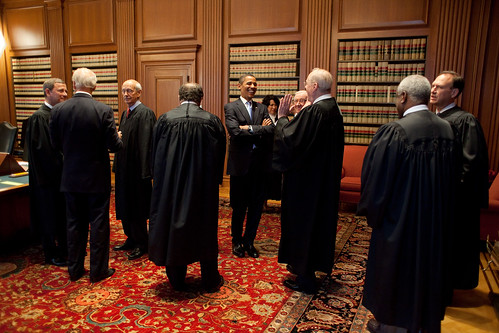
Let's analyze this picture of Obama and the Justices (and Biden).

Keep in mind that this is the shot the White House chose to put up on its Flickr page. (There's also this pic of Obama shaking hands with his appointee Sonia Sotamayor — with Scalia looking thoroughly delighted.)


(Enlarge.)

That's Biden, on the left, with his back to the camera, talking to Breyer and Roberts. The charming Roberts looks charmed by the gasbag VP, while Breyer — though more liberal than Roberts — looks like he's sleeping on his feet.

The short hulk by himself with his back to the camera is Scalia. Also alone, lurking in the background, is the newest Justice, Sonia Sotomayor. Or is Ruth Bader Ginsburg back there too (in the ladies section?) out of camera range?

Brooding over on the extreme right are Justice Thomas and Alito.

In the center, there's the President. As Stevens looks on, Obama laughs at Justice Kennedy's vain effort to enlist the Prez in a game of pattycake. Oh! Pattycake! Such fun!

IN THE COMMENTS: Freeman Hunt says:
Imagine holding a party. Your spouse takes pictures. When the guests leave, you say, "I'll email a group picture to you all."

The guests check their email accounts the next morning to find a picture wherein all of them have their backs to the camera or are by some other means obscured. Except you. You stand, fully visible, smiling broadly, center frame.

He he he.

That strip search was unreasonable — and unconstitutional — but it was not unreasonable for the school authorities not to know that.

Said the Supreme Court today in Safford Unified School District v. April Redding:
"What was missing from the suspected facts that pointed to Savana was any indication of danger to the students from the power of the drugs or their quantity, and any reason to suppose that Savana was carrying pills in her underwear," Justice David Souter wrote in the majority opinion. "We think that the combination of these deficiencies was fatal to finding the search reasonable."...

The court also ruled the officials cannot be held liable in a lawsuit for the search. Different judges around the nation have come to different conclusions about immunity for school officials in strip searches, which leads the Supreme Court to "counsel doubt that we were sufficiently clear in the prior statement of law," Souter said.
School officials enjoy immunity from lawsuits for damages when the case law isn't clear enough that they should have known what they were doing is unconstitutional. Presumably, this case makes it clear now, and school officials can't be looking for drugs in a girl's panties unless they've got more information about the power and the quantity of the drugs and some reason to think the drugs are in the panties — more information than the accusation from another student that the girl had given her drugs.

Justices John Paul Stevens and Ruth Bader Ginsburg disagreed with the part about immunity, and Justice Thomas, standing alone, disagreed that the search was unconstitutional:
"It was eminently reasonable to conclude the backpack was empty because Redding was secreting the pills in a place she thought no one would look," Thomas said.

Thomas warned that the majority's decision could backfire. "Redding would not have been the first person to conceal pills in her undergarments," he said. "Nor will she be the last after today's decision, which announces the safest place to secrete contraband in school."
Thomas leads the pack in deference to school authorities. Remember Morse v. Frederick, the "Bong Hits for Jesus" case? There, dealing with free speech rights, he wrote:
In light of the history of American public education, it cannot seriously be suggested that the First Amendment “freedom of speech” encompasses a student’s right to speak in public schools. Early public schools gave total control to teachers, who expected obedience and respect from students. And courts routinely deferred to schools’ authority to make rules and to discipline students for violating those rules. Several points are clear: (1) under in loco parentis, speech rules and other school rules were treated identically; (2) the in loco parentis doctrine imposed almost no limits on the types of rules that a school could set while students were in school; and (3) schools and teachers had tremendous discretion in imposing punishments for violations of those rules....

To be sure, our educational system faces administrative and pedagogical challenges different from those faced by 19th-century schools. And the idea of treating children as though it were still the 19th century would find little support today. But I see no constitutional imperative requiring public schools to allow all student speech. Parents decide whether to send their children to public schools.... If parents do not like the rules imposed by those schools, they can seek redress in school boards or legislatures; they can send their children to private schools or home school them; or they can simply move. Whatever rules apply to student speech in public schools, those rules can be challenged by parents in the political process.
Related Posts Plugin for WordPress, Blogger...
