Chief Justice Roberts writes the opinion, with only Justice Alito dissenting. Justice Breyer has a concurring opinion. From the Roberts opinion:
The picketing was conducted under police supervision some 1,000 feet from the church, out of the sight of those at the church. The protest was not unruly; there was no shouting, profanity, or violence....
Given that Westboro’s speech was at a public place on a matter of public concern, that speech is entitled to “special protection” under the First Amendment. Such speech cannot be restricted simply because it is upsetting or arouses contempt. “If there is a bedrock principle underly- ing the First Amendment, it is that the government may not prohibit the expression of an idea simply because society finds the idea itself offensive or disagreeable.” Texas v. Johnson, 491 U. S. 397, 414 (1989). Indeed, “the point of all speech protection . . . is to shield just those choices of content that in someone’s eyes are misguided, or even hurtful.” Hurley v. Irish-American Gay, Lesbian and Bisexual Group of Boston, Inc., 515 U. S. 557, 574 (1995)....
Speech is powerful. It can stir people to action, move them to tears of both joy and sorrow, and—as it did here— inflict great pain. On the facts before us, we cannot react to that pain by punishing the speaker. As a Nation we have chosen a different course—to protect even hurtful speech on public issues to ensure that we do not stifle public debate. That choice requires that we shield West- boro from tort liability for its picketing in this case.
Clearly, this is the right outcome.
AND: Alito, the lone dissenter, stresses the value of the tort called "intentional infliction of emotional distress":
Respondents’ outrageous conduct caused petitioner great injury, and the Court now compounds that injury by depriving petitioner of a judgment that acknowledges the wrong he suffered.
In order to have a society in which public issues can be openly and vigorously debated, it is not necessary to allow the brutalization of innocent victims like petitioner.
Breyer's short concurrence makes the point that the decision is limited to in-person picketing about matters of "public concern." In adding that the Court "does not examine in depth the effect of television broadcasting" and "internet postings," I get the sense that he's looking ahead to cases about bullying.
The justices aren’t likely to be misled by the reasoning that prompted two of the four federal courts that have ruled on this legislation to invalidate it on the theory that Congress is entitled to regulate only economic “activity,” not “inactivity,” like the decision not to purchase insurance. This distinction is illusory. Individuals who don’t purchase insurance they can afford have made a choice to take a free ride on the health care system. They know that if they need emergency-room care that they can’t pay for, the public will pick up the tab. This conscious choice carries serious economic consequences for the national health care market, which makes it a proper subject for federal regulation.
Of course, the argument Tribe likes was presented, considered, and rejected in the 2 federal court cases. It's a perfectly comprehensible argument, but that doesn't make its success in the Supreme Court a sure thing. Acting as if it does, Tribe says "it’s distressing that many assume its fate will be decided by a partisan, closely divided Supreme Court." Oh, you terrible people who fail to bow to the obviousness of one side of a constitutional argument! You compound your sins by falling prey to the upsetting belief that the Supreme Court Justices are politically partisan!
To imagine Justice Scalia would abandon that fundamental understanding of the Constitution’s necessary and proper clause because he was appointed by a Republican president is to insult both his intellect and his integrity.
That's not sarcasm. Read the whole thing. You'll see, it's not intentional sarcasm. It might be an attempt to sweet-talk Scalia into using the health-care litigation to score some political neutrality points, but it's not sarcasm. It's more: Ah! What a fine Justice, full of integrity and intellect, I will say Justice Scalia is if he decides this case my way!
Justice Anthony Kennedy, whom many unfairly caricature as the “swing vote,” deserves better as well.
Oh! People are sooooo unfair to Justice Kennedy. I, Larry Tribe, will protect him from the scurrilous "swing vote" remarks people make.... when he decides this case my way!
I hope they do a better job of pointing at the Lopez case than that NYT link does. Here's the right link, in case anyone cares.
But that decision in 1995 drew a bright line between commercial choices, all of which Congress has presumptive power to regulate, and conduct like gun possession that is not in itself “commercial” or “economic,” however likely it might be to set off a cascade of economic effects.
Drew a bright line, eh? But the line, if you can call it a line, isn't about "commercial choices." That's Tribe's phrase — as he assures us the line is bright! — and what the Court said was "commercial activity" — which is why the argument about the distinction between activity and inactivity has been so important in the health care litigation. Tribe declares lines to be bright precisely at the point when he is shedding darkness. (If you think you can't shed darkness, I agree. I'm just riffing on the linguistic oddity of the lawyer's expression "bright line." Aren't easy-to-see lines usually dark — like black ink on white paper?)
The decision about how to pay for health care is a quintessentially commercial choice in itself, not merely a decision that might have economic consequences.
"Quintessentially" is such a strong word that perhaps you will not notice that it's next to the phrase that is not "economic activity."
Only a crude prediction that justices will vote based on politics rather than principle would lead anybody to imagine that Chief Justice John Roberts or Justice Samuel Alito would agree with the judges in Florida and Virginia who have ruled against the health care law.
Oh, come on. Tribe's rhetorical move has become comical at this point. It reminds me of an old-fashioned mother exerting moral pressure on a child by telling him how sure she is that he is such a good little boy that he could never do whatever it is she doesn't want him to do. Put more directly, it's an assertion of authority: I'm telling you what's right and if you don't do it, you'll be wrong. Could the Justices possibly yield to pressure like that? It's crude to think that they would, isn't it? It's an insult both their intellect and their integrity.
And yet, Larry Tribe does think it, right? That's what's behind his rhetoric. I believe. Crudely.
"The Supreme Court has been eating Congress' lunch by invalidating legislation with judicial activism after nominees commit under oath in confirmation proceedings to respect congressional fact finding and precedents...
"Ignoring a massive congressional record and reversing recent decisions, Chief Justice Roberts and Justice Alito repudiated their confirmation testimony given under oath and provided the key votes to permit corporations and unions to secretly pay for political advertising — thus effectively undermining the basic Democratic principle of the power of one person, one vote... Chief Justice Roberts promised to just call balls and strikes and then he moved the bases."
Bleh. You just disagree with the call. I hate this sort of political posturing. It's not the massiveness of the congressional record that makes a statute constitutional. It's fitting within the Constitution.
Specter is acting as if the question at the confirmation hearing was: If we put a really, really huge number of words into the record, do you promise to let us do anything we want? And the answer was: Yes, of course. When I see a lot of pages, I always think, wow, that must be true.
Yes, it's also the 10-year anniversary of the big Florida recount. I wish I'd been blogging then! It would have been so much fun to write about that every step of the way. I'd have liked to show you in real time that I really wanted my guy, Al Gore, to win, and I also accepted nearly everything the Supreme Court did in the complicated litigation over the recount. But there are so many missed blogging opportunities in the past. I'd have loved to have blogged the Clinton scandals too. And the Clarence Thomas hearings. The Bork hearings.
As if things couldn't get any weirder, did you notice the name of the lawyer who made the Republicans' unsuccessful arguments before that federal judge today? That would be Ted Olson, a man Washingtonians often refer to as a 'Washington super-lawyer.' Who is Ted Olson? Well, that would be the same one knee-deep in the Arkansas Project, which in league with the American Spectator spent a ton of money digging dirt on Bill Clinton in Arkansas....
Well, now, isn't that weird? I just blogged this morning about that Think Progress blogger who confronted Justice Alito and he was going on about the Arkansas Project:
Last night, the American Spectator — a right-wing magazine known for its role in the “Arkansas Project,” a well-funded effort to invent stories with the goal of eventually impeaching President Clinton — held its annual gala fundraising event....
That first TPM post wove Justice Scalia into its conspiracy-ish riff:
Of course, Olson... is also the Olson from Morrison v. Olson, the supreme court case which upheld the constitutinality of the Independent Counsel statute. Olson was against it. Come to think of it, we Dems now think he and Scalia were right. So maybe chalk one up in his favor.
So that's how TPM first talked about law. Yikes. Spelled "constitutionality" wrong too.
I'm going to start reading the lefty blogs more and writing about them, I think. I'm interested in the way they string ideas together, and I think they need some more push back.
"While I know Harriet would have made a fine justice, I didn't think enough about how the selection would be perceived by others," Mr. Bush writes. "I put my friend in an impossible situation. If I had to do it over again, I would not have thrown Harriet to the wolves of Washington."...
--After he tapped Roberts for chief justice when William Rehnquist died, he only considered women candidates to replace O'Connor. "I didn't like the idea of the Supreme Court having only one woman."
But Roberts was originally picked for the O'Connor position. The idea of appointing a woman, then, didn't matter all that much.
--There were "frustrating roadblocks" for most of the women candidates. When several senators said they were impressed by Miers, he concluded "she would make an outstanding justice." Miers was "shocked" when he asked if she was interested.
--No one in the White House ever suggested conservatives would revolt over her nomination. Bush suggests the opposition was elitist because Miers didn't go to an Ivy League school and "is not glib."
In addition to Miers, Bush says he considered Patricia Owen, but he thought Miers would be easier to confirm. After all the trouble with Miers, he switched to Alito, who, he writes, was "ill at ease" with Bush at first. Bush relaxed him by talking about baseball.
Bush says wanted to avoid appointing another Souter — Souter, who disappointed Bush's father, by "evolv[ing] into a different kind of judge."
--Roberts was not the unanimous choice. Vice President Cheney and Attorney General Alberto Gonzales backed Judge Mike Luttig. Miers supported Alito. Chief of Staff Andy Card and adviser Karl Rove favored Roberts. (Which means J. Harvie Wilkinson and Edith Brown Clement, the other two contenders early on, didn't have prominent backers.)
--Brett Kavanaugh, now a federal appeals court judge, told Bush Luttig, Alito and Roberts would all be solid justices. He suggested Bush ask a "tiebreaker question" of which man would be the most effective leader. To Bush, that was Roberts.
It seems that Roberts has a special appeal to Bush, who liked his "gentle soul" and "quick smile."
Justice Ginsburg writes for the majority in Christian Legal Society v. Hastings College of the Law, answering yes to the question: "May a public law school condition its official recognition of a student group — and the attendant use of school funds and facilities — on the organization’s agreement to open eligibility for membership and leadership to all students?" The CLS wanted to restrict membership to those who would sign a "statement of faith" and to exclude those who engage in "unrepentant homosexual conduct."
Justice Ginsburg expresses deference to the law school's reasonable and "viewpoint-neutral" policymaking:
Hastings... could reasonably expect more from its law students than the disruptive behavior CLS hypothesizes—and to build this expectation into its educational approach. A reasonable policy need not anticipate and preemptively close off every opportunity for avoidance or manipulation. If students begin to exploit an all-comers policy by hijacking organizations to distort or destroy their missions, Hastings presumably would revisit and revise its policy.
That final "if" is important, and it takes a lot of the wind out of the sails of the dissenting opinion written by Justice Alito. From the dissent:
In response to the argument that the accept-all-comers-policy would permit a small and unpopular group to be taken over by students who wish to silence its message, the Court states that the policy would permit a registered group to impose membership requirements “designed to ensure that students join because of their commitment to a group’s vitality, not its demise.” With this concession, the Court tacitly recognizes that Hastings does not really have an accept-all-comers policy—it has an accept-some-dissident-comers policy—and the line between members who merely seek to change a group’s message (who apparently must be admitted) and those who seek a group’s “demise” (who may be kept out) is hopelessly vague.
The majority is deferring to the law school, and not preemptively dealing with this other situation which hasn't happened and which it would prefer to trust the law school to deal with if in fact it ever does happen.
In this morning's opinion in McDonald v. City of Chicago, Justice Alito writes for a majority, explaining the doctrine of incorporation with useful clarity. The question to be answered is: "whether the right to keep and bear arms is fundamental to our scheme of ordered liberty... or as we have said in a related context, whether this right is 'deeply rooted in this Nation’s history and tradition" (page 19 of the opinion).
Applying that standard:
Our decision in Heller points unmistakably to the answer. Self-defense is a basic right, recognized by many legal systems from ancient times to the present day, and in Heller, we held that individual self-defense is “the central component” of the Second Amendment right.... (stating that the “inherent right of self-defense has been central to the Second Amendment right”). Explaining that “the need for defense of self, family, and property is most acute” in the home, we found that this right applies to handguns because they are “the most preferred firearm in the nation to ‘keep’ and use for protection of one’s home and family”.... Thus, we concluded, citizens must be permitted “to use [handguns] for the core lawful purpose of self-defense.”
Heller makes it clear that this right is “deeply rooted in this Nation’s history and tradition.”
Justice Alito — at page 42 — rejects the 4 factors that Justice Breyer, in his dissenting opinion, argues should affect incorporation:
First, “there is no popular consensus” that the right is fundamental; second, the right does not protect minorities or persons neglected by those holding political power; third, incorporation of the Second Amendment right would “amount to a significant incursion on a traditional and important area of state concern, altering the constitutional relationship between the States and the Federal Government” and preventing local variations; and fourth, determining the scope of the Second Amendment right in cases involving state and local laws will force judges to answer difficult empirical questions regarding matters that are outside their area of expertise. Even if we believed that these factors were relevant to the incorporation inquiry, none of these factors undermines the case for incorporation of the right to keep and bear arms for self-defense.
The only Justice who has not issued a majority opinion from [the November] sitting is Justice Stevens, which makes him the very likely author. Justice Stevens tends to take a narrow view of patent rights...
I ultimately predict that the Bilski majority opinion will be authored by Justice Stevens and that the decision will be very significant in its narrowing of the scope of method patents.
2. Free Enterprise Fund v. Public Company Accounting Oversight Board:
[N]either the Chief Justice nor Justice Kennedy has authored an opinion from [the December] sitting... [but] Chief is ... unlikely to leave himself without an opinion in a sitting.
If I’m right, that means that the PCAOB’s structure is likely to be invalidated as unconstitutional. At oral argument the Chief Justice asked no questions of counsel to the plaintiffs and was hostile to the defense of the statute....
3. McDonald v. City of Chicago:
[T]he only Justice not to write from [the February] sitting is Justice Alito....
I predict that Justice Alito will write the Court’s opinion in McDonald recognizing that the Second Amendment is incorporated [in the 14th Amendment and thus applicable to state and local government]....
4. Christian Legal Society v. Martinez:
Neither Justice Stevens nor Justice Ginsburg authored an opinion from [the April] sitting....
Though it is very difficult to tell, I think that the most likely outcome in these circumstances is that Justice Ginsburg will issue a majority opinion in favor of Hastings Law School on the relatively narrow basis that the plaintiffs stipulated that the school had a neutral “all comers” policy that did not discriminate against this group but instead provided that all groups must accept all students
We shall see. It's a big Supreme Court day tomorrow. The Court's Term ends, with the retirement of Justice Stevens, and the hearings on the Kagan nomination begin.
United States v. Comstock, today's Supreme Court case upholding the federal civil-commitment statute, deals only with the question whether Congress has an enumerated power to make a law that authorizes the continued detention of sexual dangerous or mentally ill persons after they have completed serving their federal prison sentences. That is, the case is not about whether there is an individual right to be free of this deprivation of liberty — only whether the federal government can do it.
On this federalism question, the Court relies on the Necessary and Proper Clause of the Constitution. The persons who are detained have, in every case, been convicted of federal crimes. If there was federal power to create those crimes and to impose criminal punishment for them, then why wouldn't it follow that the federal government could do something more to those individuals? Justice Breyer writes for the majority: "the same enumerated power that justifies the creation of a federal criminal statute... justifies civil commitment...."
[T]he statute is a “necessary and proper” means of exercising the federal authority that permits Congress to create federal criminal laws, to punish their violation, to imprison violators, to provide appropriately for those imprisoned, and to maintain the security of those who are not imprisoned but who may be affected by the federal imprisonment of others. The Constitution consequently authorizes Congress to enact the statute.
Justice Kennedy writes separately to note that federalism concerns have been adequately tended to: "this is a discrete and narrow exercise of authority over a small class of persons already subject to the federal power." Ditto Alito: "This is not a case in which it is merely possible for a court to think of a rational basis on which Congress might have perceived an attenuated link between the powers underlying the federal criminal statutes and the challenged civil commitment provision. Here, there is a substantial link to Congress’ constitutional powers."
Absent congressional action that is in accordance with, or necessary and proper to, an enumerated power, the duty to protect citizens from violent crime, including acts of sexual violence, belongs solely to the States....
Not long ago, this Court described the Necessary and Proper Clause as “the last, best hope of those who defend ultra vires congressional action.” ... Regrettably, today’s opinion breathes new life into that Clause, and... comes perilously close to transforming the Necessary and Proper Clause into a basis for the federal police power that “we always have rejected"... In so doing, the Court endorses the precise abuse of power Article I is designed to prevent—the use of a limited grant of authority as a “pretext . . . for the accomplishment of objects not intrusted to the government.”
At his confirmation hearing, lawprof Goodwin Liu, nominated for the 9th Circuit Court of Appeals, is being taken to task by Senator Kyl for what he said at Samuel Alito's confirmation hearing. (There is also talk of Liu as a future Supreme Court nominee.)
“Judge Alito’s record envisions an America where police may shoot and kill an unarmed boy to stop him from running away with a stolen purse … where a black man may be sentenced to death by an all-white jury for killing a white man,” Liu wrote. “I humbly submit that this is not the America we know. Nor is it the America we aspire to be.”
The testimony was “vicious, emotionally and racially charged, very intemperate, and to me it calls into question your ability to approach and characterize people’s positions in a fair and judicious way,” Kyl said.
Liu only acknowledged that this language was “unnecessarily flowery.”
The architects of the Rehnquist federalism revolution....
Go to the link for some detail on what Greenhouse likes to call the "federalism revolution."
.... were Chief Justice William H. Rehnquist and his fellow Arizonan, Justice Sandra Day O’Connor (Chief Justice Rehnquist was actually from Milwaukee, but he decided during his Army service in North Africa that he liked the air of the desert rather than the cold and damp of the Great Lakes.) They were Westerners to whom the notion of states’ rights came naturally.
But Chief Justice John G. Roberts Jr. is not William Rehnquist, and Justice Samuel A. Alito Jr. is not Sandra Day O’Connor. John Roberts has made his career inside the Beltway ever since coming to Washington to clerk for Rehnquist. As for Sam Alito, I don’t believe that apart from a brief part-time gig as an adjunct law professor, this former federal prosecutor, Justice Department lawyer and federal judge has cashed a paycheck in his adult life that wasn’t issued by the federal government. Nothing in their backgrounds or in their jurisprudence so far indicates that they are about to sign up with either the Sagebrush Rebellion or the Tea Party.
Chief Justice Roberts appears particularly in tune with the exercise of national power.
Here, Greenhouse notes 2 dissenting opinions —Massachusetts v. Environmental Protection Agency, where Roberts would have saved the EPA from the state's lawsuit to force it to deal with global warming, and Gonzales v. Oregon, where Roberts would have let the United States attorney general keep doctors from prescribing the suicide drugs that were authorized by Oregon law.
Finally, Greenhouse aptly observes that even some of the Justices who favor the states in federalism decisions lose their nerve when they are confronted with "issues that people really care about." Chief Justice Rehnquist balked when he got to the Family and Medical Leave Act (in Nevada Department of Human Resources v. Hibbs) — and that case was only about whether an employee of a state could get back pay when the act was violated, not the more momentous question of whether the act was constitutional or could bind the state.
So now we have a monumental new law. Can we really imagine the Supreme Court thwarting it?
John Roberts is an acutely image-conscious chief justice, as watchful and protective of the Supreme Court’s image as he is of his own. I find it almost impossible to believe that this careful student of history would place his court in the same position as the court that has been rewarded with history’s negative judgment for thwarting the early New Deal.
But the Supreme Court got cold feet about standing up to the will of the democratic branches of government right after Franklin Roosevelt won a big landslide election in 1936. The health care reform law followed an election that wasn't about health care reform at all. The main thing people were thinking about when they voted for Obama in 2008 was the dramatic economic crisis. There were also the 2 wars and amorphous hopes for a post-racial America.
The 2008 election cannot be read as a mandate for health care reform, especially not for the aspect of it that is challenged in the current lawsuits: the individual mandate to buy health insurance. That could not possibly have been foremost in the voters' minds. First, during the campaign, Obama spoke emphatically against it. And second, even after a year of talk about the reform, people don't really understand what the individual mandate is going to be.
There isn't a big majority of Americans who are counting on being compelled to buy insurance. There isn't even a majority — even a thin majority — of Americans who favor the health care reform as a whole, and this is even before they need to confront something that is probably going to shock and distress a lot of people who haven't studied the text of the law and have simply trusted that the government is about to give them the good things they need.
Greenhouse tries to patch this hole in her argument:
Midweek polls showed the public already rallying around the new health care law. That trend is likely to accelerate as people realize that the law’s benefits belie the scare stories — just around that time that the state challenges are likely to reach the Supreme Court. It won’t require a summa cum laude in history from Harvard to be able to tell history’s wrong side from its right.
Kudlow has expressed some interest in mounting a bid. One of the men who's urging him to run, self-proclaimed "Wall St. guy" and Kudlow friend John Lakian, told me today that Kudlow is at "the 70 or 80 or 90% tipping point" toward throwing his hat in the ring. According to Lakian, one of the men behind the Draft Kudlow movement on Facebook and the web, the time is right for a man with Kudlow's extensive Wall St. connections to make a run for office.
"There's no question we'd be an underdog," Lakian said when I asked him how tough it would be for Kudlow or any other Republican to challenge Schumer's considerable war chest. But Lakian said that the new campaign finance rules set down in the Citizens United case would help close the money gap for Kudlow quite quickly.
Citizens United is not about campaign contributions. It's about independent spending. McMorris-Santoro would like his readers to think that corporations can fill up a "war chest" for a Republican challenger to match that of the long-time incumbent's. Alito-like, I'm mouthing the words: not true.
... Schumer is a formidable fundraiser who's sitting on $19 million in campaign funds. The DSCC did not respond to a request for comment about Schumer potential vulnerability.
So "Citizens United case would help close the money gap for Kudlow quite quickly" and the gap is $19 million?!
Why wasn't here there at the State of the Union address, mouthing "not true" along with Justice Alito?
I don’t go because it has become so partisan and it’s very uncomfortable for a judge to sit there. There’s a lot that you don’t hear on TV — the catcalls, the whooping and hollering and under-the-breath comments.
One of the consequences [presumably of Alito's display] is now the court becomes part of the conversation, if you want to call it that, in the speeches. It’s just an example of why I don’t go.
Alito, so serenely beatific and floating in the moment ...
Roberts, beset with inner turmoil and straining to keep himself clamped in ...
... as the President arrived to deliver his State of the Union Address:
And so it would be not be the model of judicial restraint, Chief Justice Roberts, whose personal reaction would break the solemn decorum of the holy chamber. It would be Justice Alito, in a moment of selfless abandon, whose spirit would burst forth — open the floodgates — in a harrowing crisis of faith — the dark night of the soul that says not true.
Really, it drives me crazy to try to plow through the unedited dreck that Greenwald writes, but I feel compelled to defend Justice Samuel Alito who, when affronted by President Obama's accusation that the Supreme Court violated judicial norms, simply shook his head and mouthed (apparently) "not true."
Greenwald accuses Alito of "a serious and substantive breach of protocol that reflects very poorly on Alito and only further undermines the credibility of the Court." Further! Presumably, you're already against the Supreme Court, and Greenwald isn't using this post to bring you up to speed.
It has nothing to do with etiquette and everything to do with the Court's ability to adhere to its intended function.
There's a reason that Supreme Court Justices -- along with the Joint Chiefs of Staff -- never applaud or otherwise express any reaction at a State of the Union address. It's vital -- both as a matter of perception and reality -- that those institutions remain apolitical, separate and detached from partisan wars.
Uh, yeah, which is why Obama's words were such an affront. Obama called the Citizens United case a "wrong," that is, a legal outrage of some sort, but, obviously, Alito's position is that the Court decided the case according to the law, that it said what the First Amendment means, and that its legal expertise is entitled to respect.
Alito's response didn't signify political disagreement. It was simply self-defense — a defense of the Court. It meant: We decide cases according to the law. That is apolitical.
Justice Alito's flamboyantly insinuating himself into a pure political event, in a highly politicized manner, will only hasten [the Court's] decline.
Shaking one's head and mouthing 2 or 3 words is "flamboyant"? Alito was sitting in his seat and he evinced a subtle reaction to a severe political attack. That doesn't make what he did "highly politicized." If anyone was "highly politicized," it was Obama. Alito's response was more of a reflex, and it was, I would assume, grounded in a belief that the Court does what it is supposed to do — decide cases according to the law.
On a night when both tradition and the Court's role dictate that he sit silent and inexpressive, he instead turned himself into a partisan sideshow -- a conservative Republican judge departing from protocol to openly criticize a Democratic President...
Oh, bullshit. He's a sideshow because he flinches when hit? He's modestly human and not a mannequin. I remember when Obamaexpressed a desire for Supreme Court Justices with a more sensitive emotional response. Empathy.
Obama is an elected politician in a political branch and has every right to express his views on such a significant court ruling. While the factual claims Obama made about the ruling are subject to reasonable dispute, they're well within the realm of acceptable political rhetoric and are far from being "false"...
But shouldn't Obama have shown some respect for the members of the third branch of government who honored him with their presence? What is the "acceptable political rhetoric" when one person has the microphone for over an hour and everyone else is supposed to listen respectfully? Really, if it were known in advance that Obama wanted to use the occasion this way, the Supreme Court Justices should have stayed home. Or send over 1 or 2 that do opinions that the big man likes.
The link goes to Tony Mauro at The Legal Times, who says that this kind of talk is "almost unprecedented." "Almost unprecedented" = "far from unprecedented"? Come on, Glenn. Your sleaziness is showing.
[Alito] unmasked himself as a politicized and intemperate Republican as well.
Huh? Alito flinched at a surprising jab. The President told the Justices to their face that they were, essentially, power abusers. It's not "Republican" to believe that your work is dutiful and honest. (Is it?) Alito's gestures meant nothing more than that.
Yale Law Professor Jack Balkin documents that roughly 25% of Franklin Roosevelt's 1937 State of the Union address was devoted to criticizing the Supreme Court and various rulings which struck down his domestic legislation.
Roosevelt's attack on the Court — quoted by Balkin — was, at the most severe point: "We do not ask the Courts to call non-existent powers into being, but we have a right to expect that conceded powers or those legitimately implied shall be made effective instruments for the common good." Think about how much more respectful that was toward the Court than the blow that made Samuel Alito flinch last night.
Greenwald concludes:
Whatever one thinks of the one paragraph of Obama's address devoted to the Citizens United ruling, it was not "unprecedented."
Who is he quoting there? Balkin doesn't say "unprecedented." Is it Mauro's "almost unprecedented"? For all his annoying verbiage, Greenwald can't get anywhere in this effort to show that Obama was just fine and Alito did something outrageous. Pathetic!
Isn't it fascinating that the lengthy, amplified, magnified speech of the most powerful man in the world with his big captive audience — in the magnificent room and in smaller rooms all over the country — is outweighed by one man's headshake and silent mouthing of 2 or 3 words?
And isn't it ironic that, right when we saw the judge's minimalist expression that overwhelmed the President's torrent of words, Obama was railing about the "powerful interests" that would use their great wealth to speak far too much during election campaigns?
It's not how much or how loud you speak that counts, is it?
ADDED: I've changed the word "are" in the "Isn't it fascinating" paragraph to "is" to correct an error that I noticed after the paragraph got quoted in full at Instapundit and Volokh. Do I write to them and ask them to take the trouble to correct my error, or do I just sit here and feel awful about it? The embarrassing clumsiness was caused by changing "lengthy, amplified, magnified words" to "lengthy, amplified, magnified speech," which I did because I didn't like the repetition of the word "words" — which is the kind of writing flaw that is hardly even embarrassing but absorbs my attention.
Last week, the Supreme Court reversed a century of law to open the floodgates for special interests — including foreign corporations — to spend without limit in our elections. Well, I don't think American elections should be bankrolled by America's most powerful interests, or worse, by foreign entities. They should be decided by the American people, and that's why I'm urging Democrats and Republicans to pass a bill that helps to right this wrong.
Obama is getting a lot of criticism. But is Alito? Alito didn't yell out his words, the way Joe Wilson did last year, and "not true" is mellower than "you lie." One expects such rigid decorum from the Justices on these occasions that it's really striking when a Justice is anything other than a statue of a Justice. I think that if they knew they were going to have to listen to that kind of in-your-face disrespect, they wouldn't have done the President the honor of sitting there, providing the scenery. But they were there, and I'm not going to criticize Alito for moving his lips and letting us see a silent defense of the judicial branch of government.
I'm reminded of all those articles, back at the time of Alito's confirmation, that said that Alito was less "polished" than John Roberts:
[H]e will never be as polished and camera-ready as Chief Justice John G. Roberts Jr. was at his own hearings a few months ago.
"He is not going to be the well-manicured nominee," said one participant in the rehearsals, known as murder boards, at which Republican lawyers have played the roles of interrogating senators. "That is not to say it is going to be worse. It is just going to be different."...
But two of Judge Alito's supporters who participated in the murder boards... said they emerged convinced that his demeanor was a political asset because it gave him an Everyman appeal.
"He will have a couple hairs out of place," one participant said. "I am not sure his glasses fit his facial features. He might not wear the right color tie. He won't be tanned. He will look like he is from New Jersey, because he is. That is a very useful look, because it is a natural look....
What is more, this participant said, Judge Alito displayed a "street smart" New Jerseyan's willingness to talk back to his questioners....
Yeah. It was different. He came from New Jersey, he looked natural, and he was willing to talk back. Silently. But we heard it. Good.
8:06 Central Time. The room looks shabby. Why is that? Here's the President. Wan applause. Kissy faces. Biden! He's looking lanky and elderly. Michelle is swathed in — what color purple would you say that is? Eggplant? Aubergine?
8:09. Nancy's in lilac. Purple is the color... if you want to appeal to all the reds and blues of America. Obama's got a red and white — peppermint — striped tie, so I take it he means to reach out to conservatives. But how? They say he's going to ask for the repeal of Don't Ask Don't Tell, but that can't please conservatives. It can't please the Democrats too much either, really — can it? — as they look toward the fall elections.
8:14. The economy sucks. But it could be worse. Obama reads the letters we write him. Letters from children. They want us to set aside partisanship. The people are resilient. And so, "I have never been more hopeful about America's future than I am tonight." First applause line.
8:19. If there's one thing that unites us, it's that we all hated the bank bailout. He talks about the bank fee, which he characterizes as a way of recovering the part of the bailout that has not yet been paid back. I've never understood that, and I don't understand it now. And it's hardly bipartisan, is it?
8:23. He's making big claims about having cut taxes and creating huge numbers of jobs. I don't believe it, but Obama is telling me that I should talk to some small business owner in Phoenix whose name I didn't quite catch. Didn't give the phone number though.
8:26. Small businesses are good. (Come on, talk to them.) Big business sucks though. We want to help small business grow... so it can become big business and then we can hate it.
8:29. China has better trains.
8:31. Biden was smiling a toothy grin but now he's all frowny-face and I'm afraid he's going to cry. Is it because other countries are better than we are? Did Obama call us losers?
8:33. It's time to get serious about solving problems. Like, before? We were clowning around.
8:35. Nuclear power plants! Off-shore oil-drilling! Yay! Really? It's mixed in with a lot of "clean energy" and "climate" talk.
8:38. Let's export more stuff.
8:41. Hey, kids! Do your homework!
8:42. $10,000 in tax credits for college (for the whole 4 years?). And you'll only have to pay 10% of your income, at the most, to pay back your college loans. After 20 years of that, any remaining debt is forgiven.
8:44. Why the hell did I get bogged down in health care reform!?
8:45. Michelle. Oh, my! What does that expression on her face mean? I get a chill and imagine she hates him. I'll go back and get a photograph of this later.
8:47. Obama takes his "share" of the blame.
8:49. We're "in a fiscal hole." Here's the part about freezing spending.
8:55. Were they laughing at him?
8:56. "Let's try common sense. A novel concept." A laugh line that is a confession of past incompetence.
8:57. He's bitching about the Supreme Court — about the Citizens United case — while the Justices are sitting right in front of him. They all look pretty poker-faced, except Samuel Alito who mouths some words. I'll have to go back and try to lip read that. [ADDED: People are reading it as "not true" and comparing that to last year's "You lie."]
9:00. Obama doesn't like the way politicians are always being politicians. "I will not give up on trying to change the tone of our politics... We still need to govern." And "we" — meaning, divisively, the Democrats — have the majority and people expect us to get things done. So the Republicans shouldn't be obstructing. Get it? Be bipartisan. Let's show everybody that "we" — and this time he means the nice, docile Republicans — are able to get things done.
9:04. He doesn't want to "relitigate" the past. What litigation was there in the past? He's referring to the old arguments about who's tougher on national security. He doesn't want us to talk about that anymore. Just accept that we all care about America. Hear that, Republicans? Don't use your strongest issue in this election year.
9:06.
9:14. We're gonna repeal Don't Ask Don't Tell. And give women equal pay for equal work. And fix immigration.
9:15. "It's our ideals — our values — that built America."
9:17. "No wonder there's so much cynicism out there. No wonder there's so much disappointment." Meade says: "Uh oh. Malaise."
9:19. He didn't say that hope and change would be easy. Yeah. He just said hope and change. And we bought it.
9:21. He's started talking about particular kids, so the end must be near. Oh, yikes, now, clearly, the end is nigh because he's yelling. I mean... getting all inspirational. "A new year has come. A new decade stretches before us. We don't quit. I don't quit." Yeah, him quitting would have been really weird! "Let's seize this moment. To start anew. To carry the dream forward. And to strengthen our union once more."
9:31. I check Site Meter to see what SOTU-related searches are bringing people to this blog. It's basically all about why everyone is wearing purple. Ha ha.
9:34. Virginia Governor Bob McDonnell gives the Republican response in the Virginia State House, which looks great. We're told it was designed by Thomas Jefferson. A nice backdrop.
9:37. The federal government is simply trying to do too much. We need to "reconsider and restore the proper limited role of government at every level."
9:40. We're blessed with natural resources "and we must use them all."
9:44. "Top-down one-size fits all decision making should not replace the personal choices of free people in a free market, nor undermine the proper role of state and local governments in our system of federalism. As our Founders clearly stated, and we Governors understand, government closest to the people governs best."
9:46: About Haiti, McDonnell directly thanks Americans: "Thank you for your ongoing compassion."
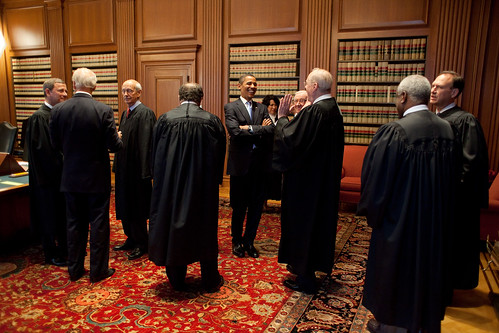
Keep in mind that this is the shot the White House chose to put up on its Flickr page. (There's also this pic of Obama shaking hands with his appointee Sonia Sotamayor — with Scalia looking thoroughly delighted.)
That's Biden, on the left, with his back to the camera, talking to Breyer and Roberts. The charming Roberts looks charmed by the gasbag VP, while Breyer — though more liberal than Roberts — looks like he's sleeping on his feet.
The short hulk by himself with his back to the camera is Scalia. Also alone, lurking in the background, is the newest Justice, Sonia Sotomayor. Or is Ruth Bader Ginsburg back there too (in the ladies section?) out of camera range?
Brooding over on the extreme right are Justice Thomas and Alito.
In the center, there's the President. As Stevens looks on, Obama laughs at Justice Kennedy's vain effort to enlist the Prez in a game of pattycake. Oh! Pattycake! Such fun!
IN THE COMMENTS: Freeman Hunt says:
Imagine holding a party. Your spouse takes pictures. When the guests leave, you say, "I'll email a group picture to you all."
The guests check their email accounts the next morning to find a picture wherein all of them have their backs to the camera or are by some other means obscured. Except you. You stand, fully visible, smiling broadly, center frame.