House Republicans suffered an embarrassing setback Tuesday when they fell seven votes short of extending provisions of the Patriot Act, a vote that served as the first small uprising of the party's tea-party bloc.Good! The Republicans don't own the Tea Party movement.
The bill to reauthorize key parts of the counter-terrorism surveillance law, which expire at the end of the month, required a super-majority to pass under special rules reserved for non-controversial measures....
The vote was the latest signal... that on certain matters House leaders could face a sizable resistance to compromise from within their own ranks, both from the 87 GOP freshmen and from conservative veterans who have been emboldened by the newcomers.
Showing posts with label surveillance. Show all posts
Showing posts with label surveillance. Show all posts
"The Patriot Act represents the undermining of civil liberties," says Dennis Kucinich, who got 26 Republicans on his side.
What happened in the House yesterday?!

"In Fifty Years We'll All Be Chicks: ... And Other Complaints from an Angry Middle-Aged White Guy."
A book title... on the list of things readers have bought via my Amazon portal...
... which I encourage you to use, of course, in case you're looking for a way to show your love for Althouse, the blog... and Althouse, the chick.
Now, I'm doing a search inside that book — it's by Adam Corolla — and — what can I look for? — shorts! What does Corolla have to say about men in shorts?
Anyway, cargo shorts... wear them, guys, to walk toward the future in which you will all be chicks.
... which I encourage you to use, of course, in case you're looking for a way to show your love for Althouse, the blog... and Althouse, the chick.
Now, I'm doing a search inside that book — it's by Adam Corolla — and — what can I look for? — shorts! What does Corolla have to say about men in shorts?
When the Patriot Act cam back in the news in 2005, every single one of my faggoty, lefty Hollywood friends squealed like a stuck pig. "I don't want the government eavesdropping on my e-mail exchanges or listening in on my cell-phone conversations." Everyone had their cargo shorts in a bunch over it. I was the only one I knew who was like, "Hey, Agent Double-O Douchebag, if the government intercepts any of your e-mails all they're going to find out is that you're not funny. And how about spending a little less time worrying about the government and a little more time focusing on your narcissistic disorder, the one that leads you to believe the government actually gives a shit about you."It's dangerous for a comedian to do a riff about how other people are not funny. He'd better be seriously funny at that point or he's asking for it.
Anyway, cargo shorts... wear them, guys, to walk toward the future in which you will all be chicks.
"Don't touch my junk." It's the new "Don't Tread on Me."
Says Charles Krauthammer.
It seems to me that these 2 things happened together: new machines that see you naked and newly intense body searches. Am I wrong to believe that the new groping procedure was intended to get more people into the scanners they would otherwise resist? Someone, at some level of the Obama administration, decided that the only way to channel people into the see-you-naked machines was to make the alternative more offensive to nearly everyone. Personally, I'd take the grope over being seen naked, but I did a poll yesterday, and I see that the scanner is significantly more popular than the grope. I suspect that was the calibration. And I suspect that if too many people choose the grope over nakedness, the plan is to intensify the grope until they get the scanner acceptance rate they need.
But why were the scanners introduced when they had to know people didn't want them? With healthcare reform, the Obama administration became associated with ramming things down our throats. The government knows what we should want and doesn't bother to find out what we do want or even to persuade us to want what they think we should. The scanners are the ultimate graphic example of forcing something on us without asking. We're only asked: Well, would you prefer to have us feeling all around your genitals? That's the kind of consent of the governed we're facing these days.
But why push the scanners on us? Do you remember hearing Obama or Janet Napolitano or anyone say anything persuasive about why these machines were bought? (Suddenly, I want to follow the money. For that, I will move to a new post.)
(In my unscientific poll, 73% of those who would keep flying, picked the scanner over the grope. I suspect the government needs a better acceptance rate than that to keep the lines flowing and justify the investment in the machines. But most of those of us who picked the grope haven't been groped yet, and if being seen naked becomes the norm, more of us may fall into that brain-dulled line that shuffles into the machine.)
Don't touch my junk is the anthem of the modern man, the Tea Party patriot, the late-life libertarian, the midterm election voter. Don't touch my junk, Obamacare - get out of my doctor's examining room, I'm wearing a paper-thin gown slit down the back. Don't touch my junk, Google - Street View is cool, but get off my street. Don't touch my junk, you airport security goon - my package belongs to no one but me....Do you remember how the government presented this newly intensified bodily search? Why did the Obama administration — which I associate with opposition to enhanced interrogation techniques used on terrorists — adopt enhanced pat-downs on ordinary citizens to protect us from terrorists? Was it done because of the introduction of the enhanced imagining scanners? I really don't know. Did the government explain this to us when I wasn't paying attention? Because I monitor the news for hours every day, and I don't know the explanation.
It seems to me that these 2 things happened together: new machines that see you naked and newly intense body searches. Am I wrong to believe that the new groping procedure was intended to get more people into the scanners they would otherwise resist? Someone, at some level of the Obama administration, decided that the only way to channel people into the see-you-naked machines was to make the alternative more offensive to nearly everyone. Personally, I'd take the grope over being seen naked, but I did a poll yesterday, and I see that the scanner is significantly more popular than the grope. I suspect that was the calibration. And I suspect that if too many people choose the grope over nakedness, the plan is to intensify the grope until they get the scanner acceptance rate they need.
But why were the scanners introduced when they had to know people didn't want them? With healthcare reform, the Obama administration became associated with ramming things down our throats. The government knows what we should want and doesn't bother to find out what we do want or even to persuade us to want what they think we should. The scanners are the ultimate graphic example of forcing something on us without asking. We're only asked: Well, would you prefer to have us feeling all around your genitals? That's the kind of consent of the governed we're facing these days.
But why push the scanners on us? Do you remember hearing Obama or Janet Napolitano or anyone say anything persuasive about why these machines were bought? (Suddenly, I want to follow the money. For that, I will move to a new post.)
(In my unscientific poll, 73% of those who would keep flying, picked the scanner over the grope. I suspect the government needs a better acceptance rate than that to keep the lines flowing and justify the investment in the machines. But most of those of us who picked the grope haven't been groped yet, and if being seen naked becomes the norm, more of us may fall into that brain-dulled line that shuffles into the machine.)
"Airport staff 'exposed woman's breasts, laughed.'"
Here come the lawsuits, riding on a wave of public emotion and credulity.
"Best to assume that we're under surveillance of one form or another most of the time."
Some advice from a professor in an article about that Duke student whose 42-page sex diary went viral on the internet. It's really sad. You know, in the old days people had God — or even just a conscience — to create that sense that they were under surveillance. And some people fretted that the government would be watching us all the time. And now, in our spiffy but impoverished age, we're supposed to manufacture responsibility out of the idea that anything can leak out into the internet.
I found that article via Instapundit, whose teaser was "INSTITUTIONALIZED SEXISM: Duke Contacting Those Affected by Sex 'Thesis.'" Sexism, eh? Maybe you can explain that to me. Are we supposed to think the university would celebrate or excuse a male student who wrote up the details of a lot of sexual encounters with female students? I get the impression Duke is trying to be equal toward the sexes by figuring out what they'd do if a bunch of female students got their privacy invaded this way and then applying the same treatment to the men.
And I still find it hard to believe that the woman — Karen Owen — wrote out her 42-page sex diary just to share it with a few friends. I imagine her laughing over the professor's advice. It may be in her interest to look like the poor girl whose friends opened her diary to the world. Look at the publicity and the readership she's getting for what was substantial literary work (plus field work!). My hypothesis is she's savvy.
I found that article via Instapundit, whose teaser was "INSTITUTIONALIZED SEXISM: Duke Contacting Those Affected by Sex 'Thesis.'" Sexism, eh? Maybe you can explain that to me. Are we supposed to think the university would celebrate or excuse a male student who wrote up the details of a lot of sexual encounters with female students? I get the impression Duke is trying to be equal toward the sexes by figuring out what they'd do if a bunch of female students got their privacy invaded this way and then applying the same treatment to the men.
And I still find it hard to believe that the woman — Karen Owen — wrote out her 42-page sex diary just to share it with a few friends. I imagine her laughing over the professor's advice. It may be in her interest to look like the poor girl whose friends opened her diary to the world. Look at the publicity and the readership she's getting for what was substantial literary work (plus field work!). My hypothesis is she's savvy.
Eliminate cash and you eliminate (much) robbery.
It would also cut down on street musicians and panhandlers. And what else? Privacy:
"If it's impossible to pay cash when you buy stuff, it's also impossible not to leave electronic footprints behind you, and the electronic footprints from what you buy put together can tell the entire story about your life. This can be very sensitive information... Most people don't want this total surveillance society."
Today's exercise in the comedy of Drudge photographic juxtapositions — AKA Drudgedy.
At Drudge right now, the picture at the very top is the Obama-with-winged-fingers that we were talking about yesterday, but let's talk about this collection of images:

This is a mysterious one, so let's brainstorm. The first thing I noticed was how that Google "You can trust us with your data" device — whatever it really is — looks like it's designed to stamp beanies onto the Pope's head or perhaps to examine/muddle/read the mind of the Pope. In the center column, the space shuttle is a simple and obvious phallic symbol. The left column — which we may interpret in relation to the giant technological phallus — is mainly hands: Nancy Pelosi's outstretched palm and Arnold Schwarzenegger's thumb-to-fingers grasp approaching 3 phallic microphones thrust toward his face.
Okay, you take it from there.

This is a mysterious one, so let's brainstorm. The first thing I noticed was how that Google "You can trust us with your data" device — whatever it really is — looks like it's designed to stamp beanies onto the Pope's head or perhaps to examine/muddle/read the mind of the Pope. In the center column, the space shuttle is a simple and obvious phallic symbol. The left column — which we may interpret in relation to the giant technological phallus — is mainly hands: Nancy Pelosi's outstretched palm and Arnold Schwarzenegger's thumb-to-fingers grasp approaching 3 phallic microphones thrust toward his face.
Okay, you take it from there.
A new Bloggingheads — called "Dangerous Minds" — with me and Jim Pinkerton.
This was recorded just a few hours a go. They got it up quick, so it must be good:
Here's a list of the highlighted topics:
Here's a list of the highlighted topics:
The Times Square bomber, immigration, and assimilationNote that they've got me on the left side of the split screen for this one. With good reason!
Does fighting terrorism require policing minds?
Jim defends Arizona’s new immigration law
Has Obama bungled the gulf oil spill? On purpose?
Ann reveals her devious Supreme Court plot
Intellectual diversity and a Harvard student’s controversial email
Terrorism and T-shirt vendors.
"At 6:28 p.m.... a video surveillance camera recorded what was believed to be the dark green Nissan S.U.V. driving west on 45th Street. Moments later, a T-shirt vendor on the sidewalk saw smoke coming out of vents near the back seat of the S.U.V., which was now parked awkwardly at the curb with its engine running and its hazard lights on. The vendor called to a mounted police officer, the mayor said, who smelled gunpowder when he approached the S.U.V. and called for assistance. The police began evacuating Times Square, starting with businesses along Seventh Avenue, including a Foot Locker store and a McDonald’s."
Take a moment to appreciate street vendors. Think of the value of their alert eyes at street level in the busiest places. Let's reflect again on what Jane Jacobs wrote in her brilliant book "The Death and Life of Great American Cities":
Take a moment to appreciate street vendors. Think of the value of their alert eyes at street level in the busiest places. Let's reflect again on what Jane Jacobs wrote in her brilliant book "The Death and Life of Great American Cities":
A well-used city street is apt to be a safe street. A deserted city street is apt to be unsafe. But how does this work, really? And what makes a city street well used or shunned? ... A city street equipped to handle strangers, and to make a safety asset, in itself, out of the presence of strangers, as the streets of successful city neighborhoods always do, must have three main qualities:Thanks to the guardians of the street.First, there must be a clear demarcation between what is public space and what is private space. Public space and private spaces cannot ooze into each other as they do typically in suburban settings or in projects.The basic requisite for such surveillance is a substantial quantity of stores and other public places sprinkled along the sidewalks of a district; enterprises and public places that are used by evening and night must be among them especially. Stores, bars and restaurants, as the chief examples, work in several different and complex ways to abet sidewalk safety.
Second, there must be eyes upon the street, eyes belonging to those we might call the natural proprietors of the street. The buildings on a street equipped to handle strangers and to insure the safety of both residents and strangers, must be oriented to the street. They cannot turn their back or blank sides on it and leave it blind.
And third, the sidewalk must have users on it fairly continuously, both to add to the number of effective eyes on the street and to induce the people in buildings along the street to watch the sidewalks in sufficient numbers. Nobody enjoys sitting on a stoop or looking out a window at an empty street. ... Large numbers of people entertain themselves, off and on, by watching street activity.First, they give people -- both residents and strangers -- concrete reasons for using the sidewalks on which the enterprises face.
Second, they draw people along the sidewalks past places which have no attractions to public use in themselves... Moreover, there should be many different kinds of enterprises, to give people reasons for crisscrossing paths.
Third, storekeepers and other small businessmen are typically strong proponents of peace and order themselves; ... they are great street watchers and sidewalk guardians if present in sufficient numbers.
Fourth, the activity generated by people on errands, or people aiming for food or drink, is itself an attraction to still other people.
Was this photo taken automatically by a school-supplied laptop without the knowledge of the sleeping teenager?
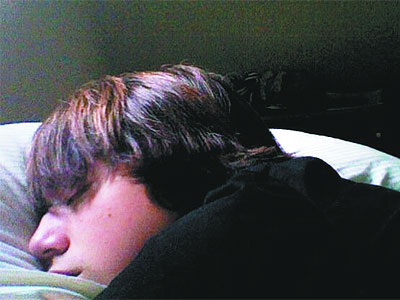
The caption:
"This photo, allegedly taken surreptitiously by the Lower Merion School District through a laptop web camera, shows Blake Robbins sleeping at home at 5 p.m. on Oct 26. (Photo provided by the Robbins family)"There is a lawsuit based on what may very well have been a terrible invasion of privacy, but I've got to marvel at how the laptop caught such a well-framed and well-lit shot of the glossy-haired boy.
According to the latest filing by the Robbinses, officials first activated the tracking software on a school-issued Apple MacBook that Robbins took home on Oct. 20.Those overreaching school officials... exposed by their own over-aggressive control-freakishness... and the devious mind-tricks of Mike and Ike!
Hundreds of times in the next two weeks, the filing says, the program did its job each time it was turned on: A tiny camera atop the laptop snapped a photo, software inside copied the laptop screen image, and a locating device recorded the Internet address - something that could help district technicians pinpoint where the machine was.
The system was designed to take a new picture every 15 minutes until it was turned off....
Robbins and his parents say they first learned of the technology on Nov. 11, when an assistant Harriton principal confronted the teen with an image collected by the tracking software.
Robbins has said one image showed him with a handful of Mike and Ike candies - which the administrator thought were illegal pills.

Everything ever written in Twitter — every little tweet, from anybody — is now archived in the Library of Congress.
Is this a wonderful preservation of a rich mine of historical and sociological information or creepy government intrusion into the private domain?
ADDED: Jull Weiner says it's "a move that’s clearly intended to out-postmodern MoMA’s acquisition of the @ symbol."
[I]t boggles my mind to think what we might be able to learn about ourselves and the world around us from this wealth of data. And I’m certain we’ll learn things that none of us now can even possibly conceive....Nerds trying to be hip?
So if you think the Library of Congress is “just books,” think of this: The Library has been collecting materials from the web since it began harvesting congressional and presidential campaign websites in 2000....
Today we hold more than 167 terabytes of web-based information, including legal blogs, websites of candidates for national office, and websites of Members of Congress.Including legal blogs....
We also operate the National Digital Information Infrastructure and Preservation Program www.digitalpreservation.gov, which is pursuing a national strategy to collect, preserve and make available significant digital content, especially information that is created in digital form only, for current and future generations.Good. I guess.
In other words, if you’re looking for a place where important historical and other information in digital form should be preserved for the long haul, we’re it!
ADDED: Jull Weiner says it's "a move that’s clearly intended to out-postmodern MoMA’s acquisition of the @ symbol."
Big Teacher Is Watching You.
"School used student laptop webcams to spy on them at school and home."
***
Orwell presaged it:The telescreen received and transmitted simultaneously. Any sound that Winston made, above the level of a very low whisper, would be picked up by it, moreover, so long as he remained within the field of vision which the metal plaque commanded, he could be seen as well as heard. There was of course no way of knowing whether you were being watched at any given moment. How often, or on what system, the Thought Police plugged in on any individual wire was guesswork. It was even conceivable that they watched everybody all the time. But at any rate they could plug in your wire whenever they wanted to. You had to live — did live, from habit that became instinct — in the assumption that every sound you made was overheard, and, except in darkness, every movement scrutinized.
Obama retreats on flag@whitehouse.gov and the public option.
1. "Following a furor over how the data would be used, the White House has shut down an electronic tip box — flag@whitehouse.gov — that was set up to receive information on 'fishy' claims about President Barack Obama’s health plan."
2. "The 'public option,' a new government insurance program akin to Medicare, has been a central component of Mr. Obama’s agenda for overhauling the health care system, but it has also emerged as a flashpoint for anger and opposition.... For Mr. Obama, giving up on the public plan would have risks and rewards. The reward is that he could punch a hole in Republican arguments that he wants a 'government takeover' of health care and possibly win some Republican votes." (Republican? If the anger was restricted to Republicans, would he care?)
2. "The 'public option,' a new government insurance program akin to Medicare, has been a central component of Mr. Obama’s agenda for overhauling the health care system, but it has also emerged as a flashpoint for anger and opposition.... For Mr. Obama, giving up on the public plan would have risks and rewards. The reward is that he could punch a hole in Republican arguments that he wants a 'government takeover' of health care and possibly win some Republican votes." (Republican? If the anger was restricted to Republicans, would he care?)
"Death panel" rhetoric — and other dysphemisms.
I'm trying to think of other examples like "death panels." Proponents of a policy will naturally give it a positive-sounding — even euphemistic — name. Opponents make their rhetorical move with a label of their own. Help me think of some examples that parallel Sarah Palin's extremely effective "death panels." I'm especially interested in terms used by Bush opponents.
I'm also trying to think of the proper term for the opposite of a euphemism. I'm seeing dysphemism, malphemism, and cacophemism on line, but not in my "hard" dictionary. (What's the retronym for a good, authoritative dictionary in book form? I've been calling it my "hard dictionary," the way you'd say "hard line" for a non-cell telephone. And I've started using my hard dictionary more and more lately, because the internet seems to verify the existence of every word and meaning.)
For the opposite of euphemism, I'm going to use dysphemism, because I think dys- is the precise opposite of eu-. Proponents tend to name their policies euphemistically, so it's fair for opponents to counter with the opposite. Dysphemism suggests that an appropriate term has been chosen to balance the positive term used by the other side. I do like the word cacophemism, but it calls to mind cacophony which — to my ear — makes it seem as though the speaker is just making noise, trying to confuse things.
Yes, yes, I know. You — some of you — think Sarah Palin was trying to confuse things when she said "death panels." But that's not my point. My point is that it's an ordinary part of debate to put new — and inflammatory — labels on policies you are opposed to.
So let's look at some dysphemisms deployed by the opponents of George W. Bush. I've come up with 2 to get us started. 1. "Eavedropping" (and "spying") to refer to Bush's domestic surveillance program (which, of course, Obama has carried on), and 2. "Gulag" for Guantanamo.
I'm also trying to think of the proper term for the opposite of a euphemism. I'm seeing dysphemism, malphemism, and cacophemism on line, but not in my "hard" dictionary. (What's the retronym for a good, authoritative dictionary in book form? I've been calling it my "hard dictionary," the way you'd say "hard line" for a non-cell telephone. And I've started using my hard dictionary more and more lately, because the internet seems to verify the existence of every word and meaning.)
For the opposite of euphemism, I'm going to use dysphemism, because I think dys- is the precise opposite of eu-. Proponents tend to name their policies euphemistically, so it's fair for opponents to counter with the opposite. Dysphemism suggests that an appropriate term has been chosen to balance the positive term used by the other side. I do like the word cacophemism, but it calls to mind cacophony which — to my ear — makes it seem as though the speaker is just making noise, trying to confuse things.
Yes, yes, I know. You — some of you — think Sarah Palin was trying to confuse things when she said "death panels." But that's not my point. My point is that it's an ordinary part of debate to put new — and inflammatory — labels on policies you are opposed to.
So let's look at some dysphemisms deployed by the opponents of George W. Bush. I've come up with 2 to get us started. 1. "Eavedropping" (and "spying") to refer to Bush's domestic surveillance program (which, of course, Obama has carried on), and 2. "Gulag" for Guantanamo.
Subscribe to:
Posts (Atom)


